These are the real platform screens, in my own account. No mock-ups: this is what a student sees every day. Interface in English; explanations and feedback in Portuguese, for Brazilian nurses.
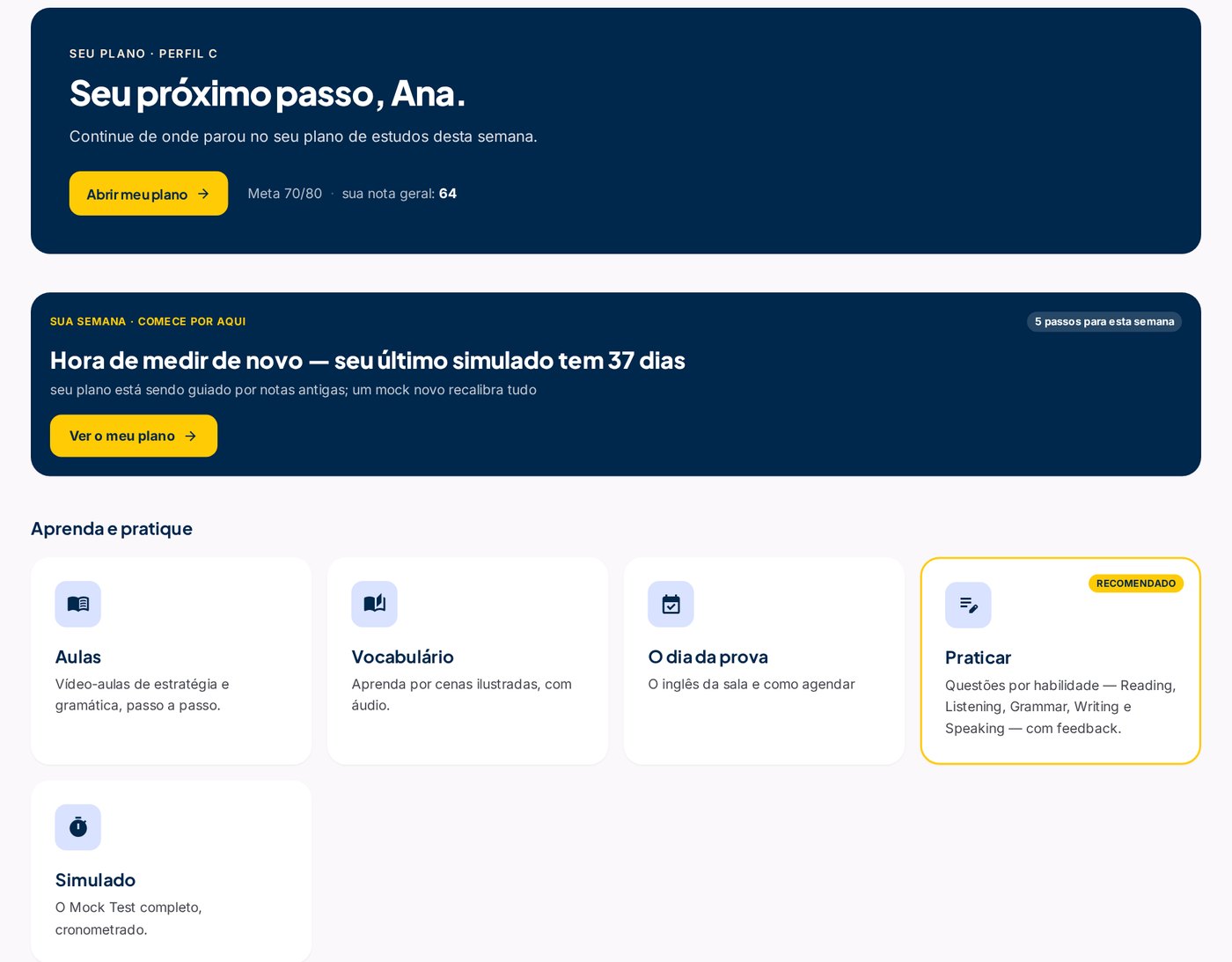
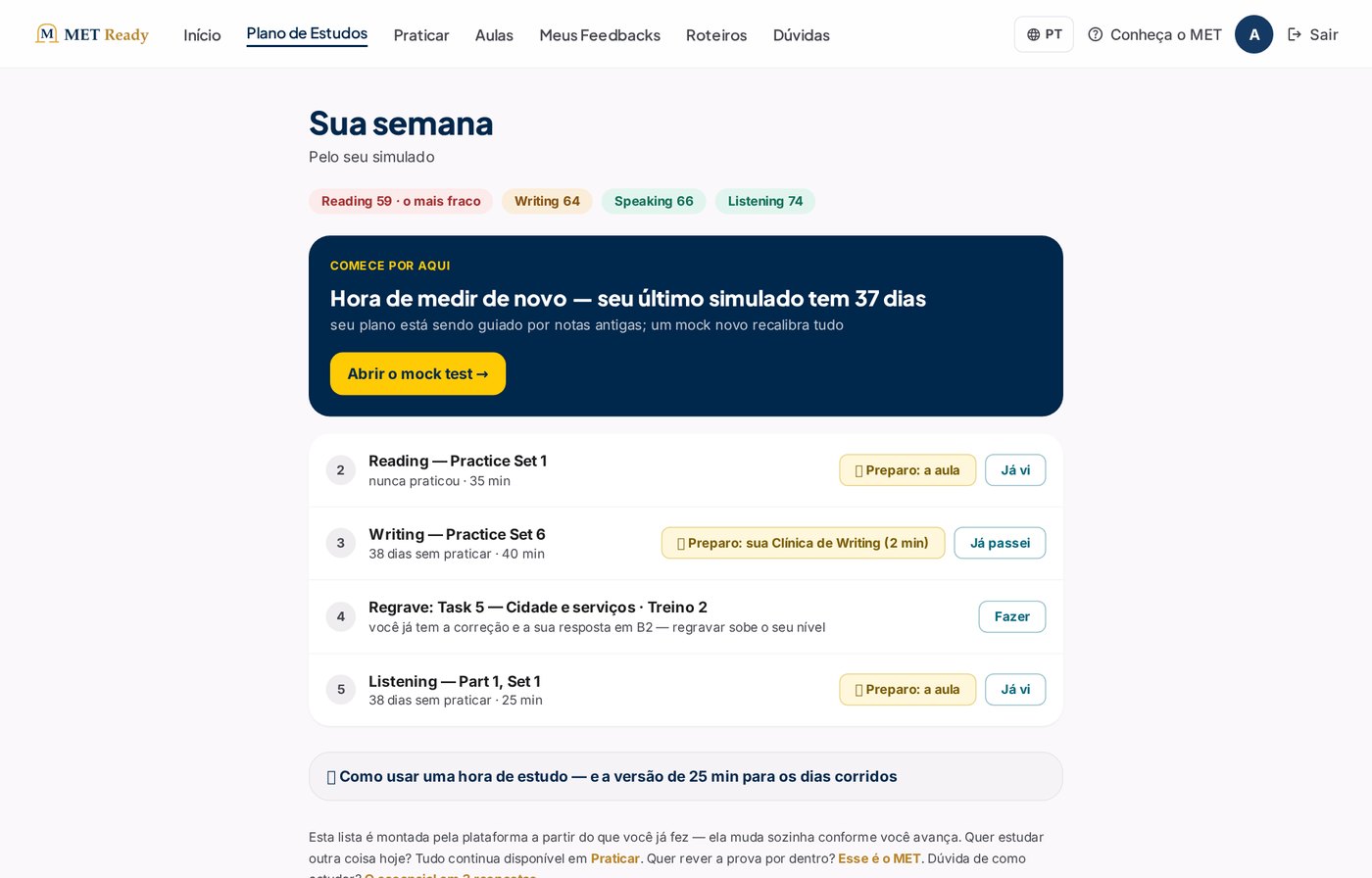
Your next step, your week, your level in each skill and your progress across mock tests, on one screen. No searching for where to start.
How you are doing
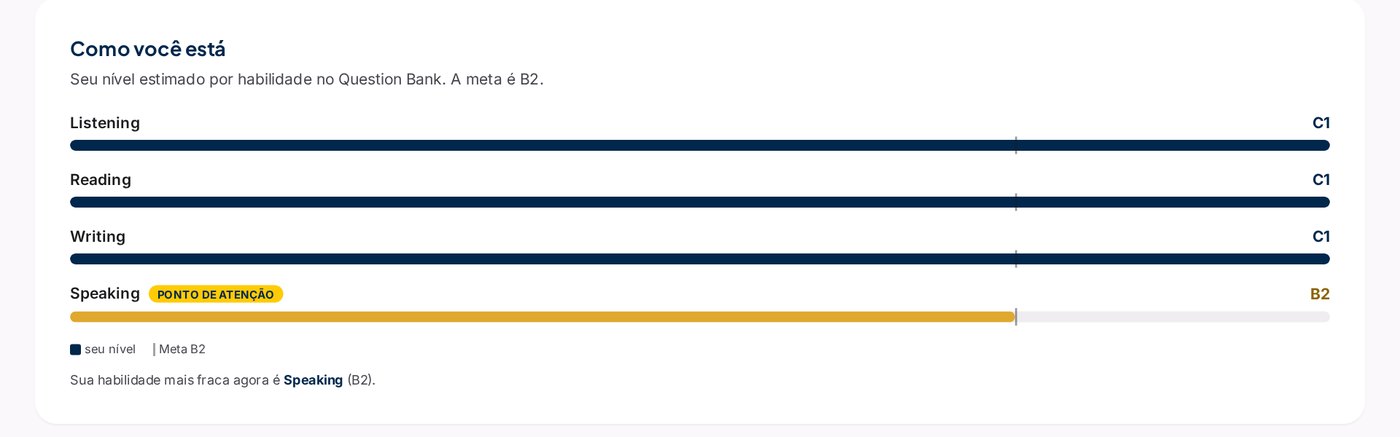
How you are doing. The estimated level in each skill, the target, and the weak point highlighted.
Recent mock tests · achievements
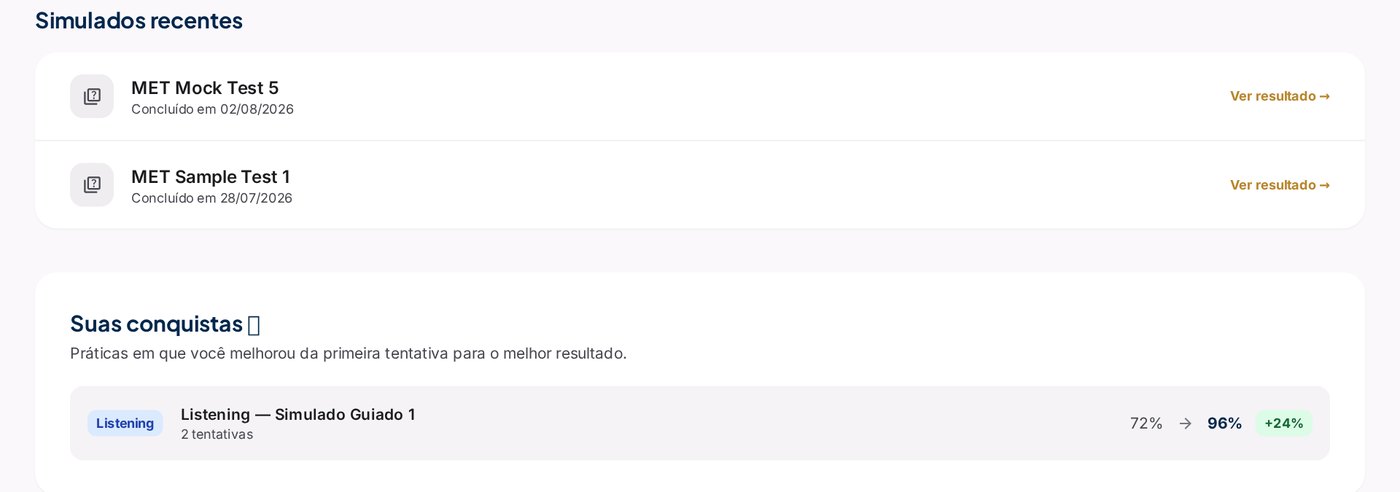
Recent mock tests and achievements. Each mock test with its result, and the practices where you improved from the first attempt to the best.
Progress across mock tests
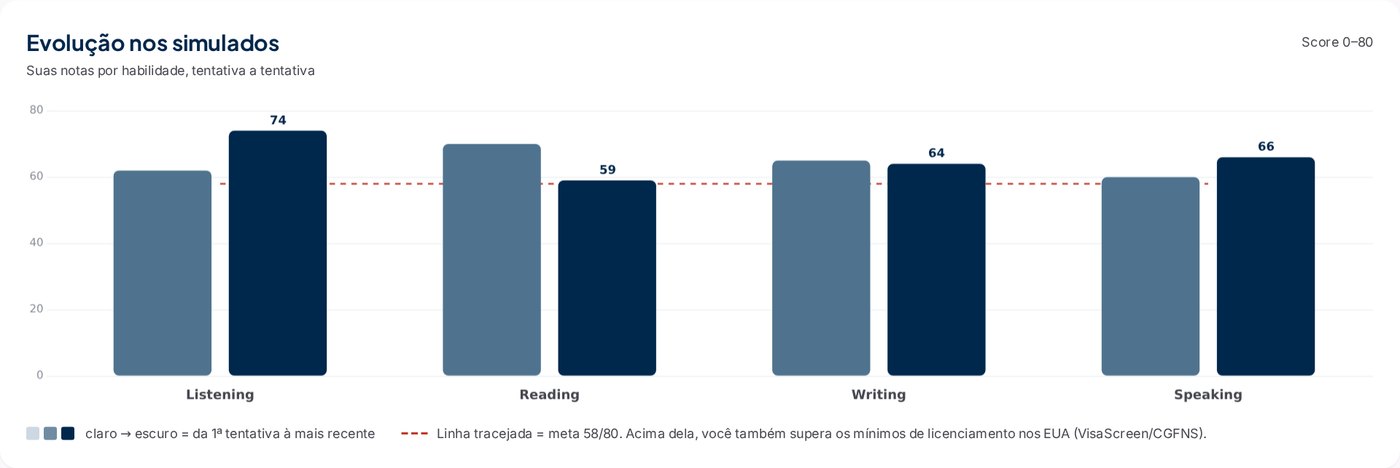
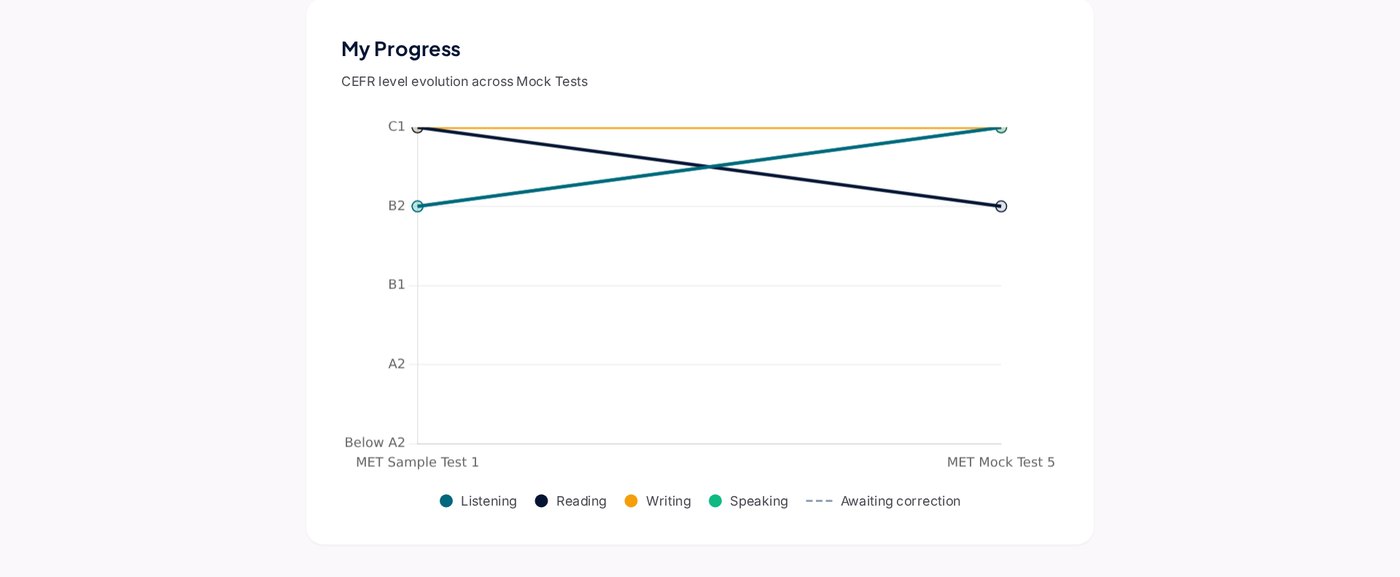
Progress across mock tests. Your scores by skill, attempt after attempt, from lightest to most recent, with the target line at 58: above it, you also clear the U.S. licensure minimums.
02
Smart Plan
You do not have to decide what to study
The platform builds your week on its own, from your history, and writes the reason behind each recommendation.
1
It looks at your history: lessons watched, exercises done, how long each skill has been untouched.
2
It covers the whole test: every week touches four different skills, the opposite of studying only what feels comfortable.
3
Booked your test date? The plan switches to final-stretch mode: mock tests, review and anxiety control.
Study Plan · Your week
Your week. Finish an item and it leaves, another comes in. Go weeks without a skill and it rises to the top.
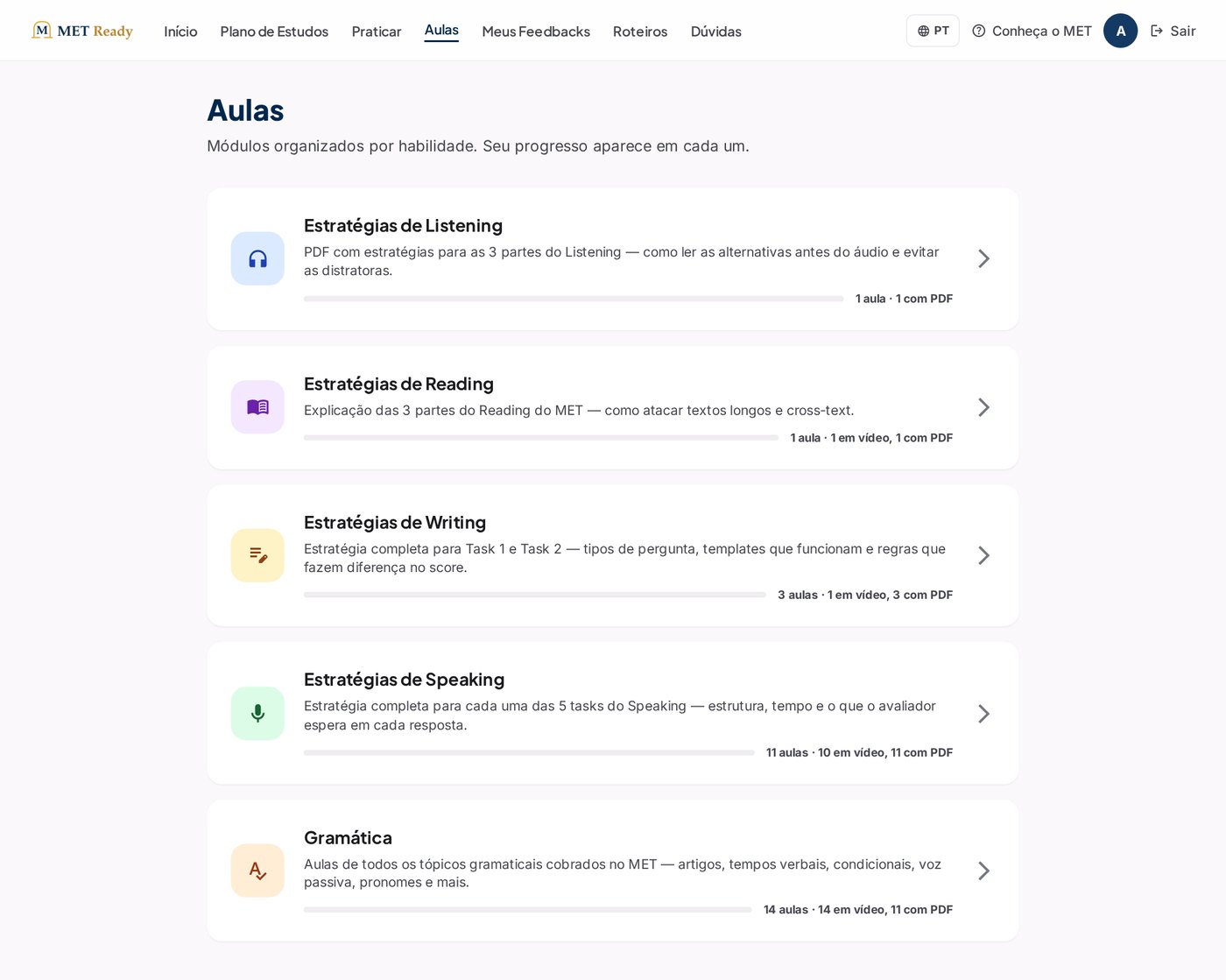
Lessons
The five modules. Listening, Reading, Writing, Speaking and Grammar, each with its own progress.
03
Lessons
Strategy for each section and the grammar the test asks for
36 video and PDF lessons. The strategy lessons explain how to answer each part; the grammar lessons cover, topic by topic, what appears in the 20 Grammar questions and what costs points in Writing and Speaking.
14
Grammar: articles, verb tenses, conditionals, passive voice, pronouns, gerund and infinitive, connectors, inversion. One video lesson per topic, with a PDF.
11
Speaking: one lesson for each of the 5 tasks, with structure, timing and what the rater expects, plus the final-stretch lessons.
3
Writing: Task 1 and Task 2, question types and the rules that make a difference to the score.
2
Listening and Reading: the 3 parts of each section, how the wrong options are built, long and cross-text passages.
04
Listening
The audio plays once. Here you train for that.
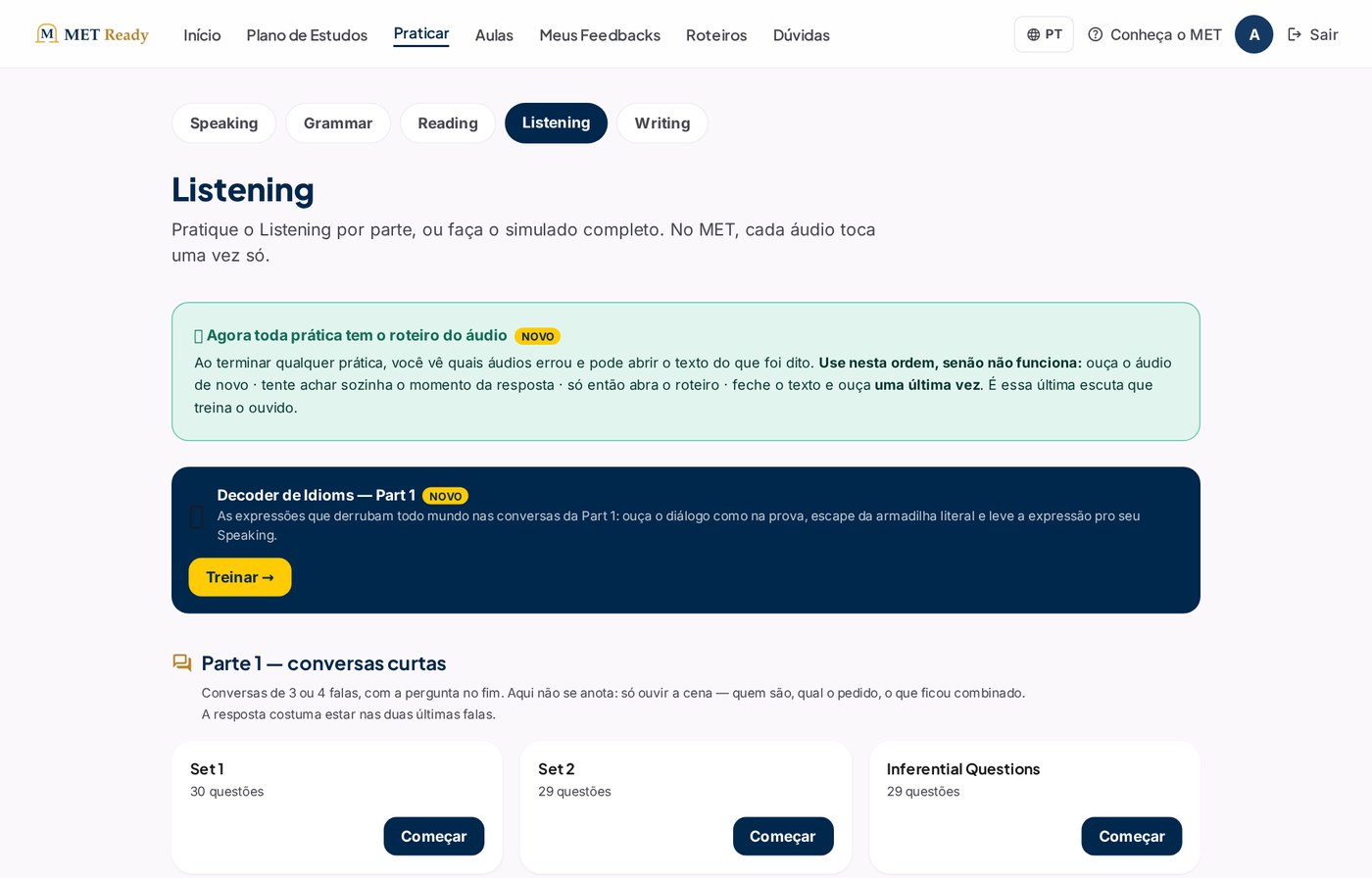
Practice by part, in the test format: short conversations, a long conversation and a talk. You answer after one listening and, at the end, read the script to find out where you got lost.
Part 1 · short conversationsPart 2 · long conversationPart 3 · talkAudio script at the endIdioms Decoder
Practice · Listening
Listening by part. The sets for each part, the script of each audio, and the Idioms Decoder with the expressions that appear in the conversations.
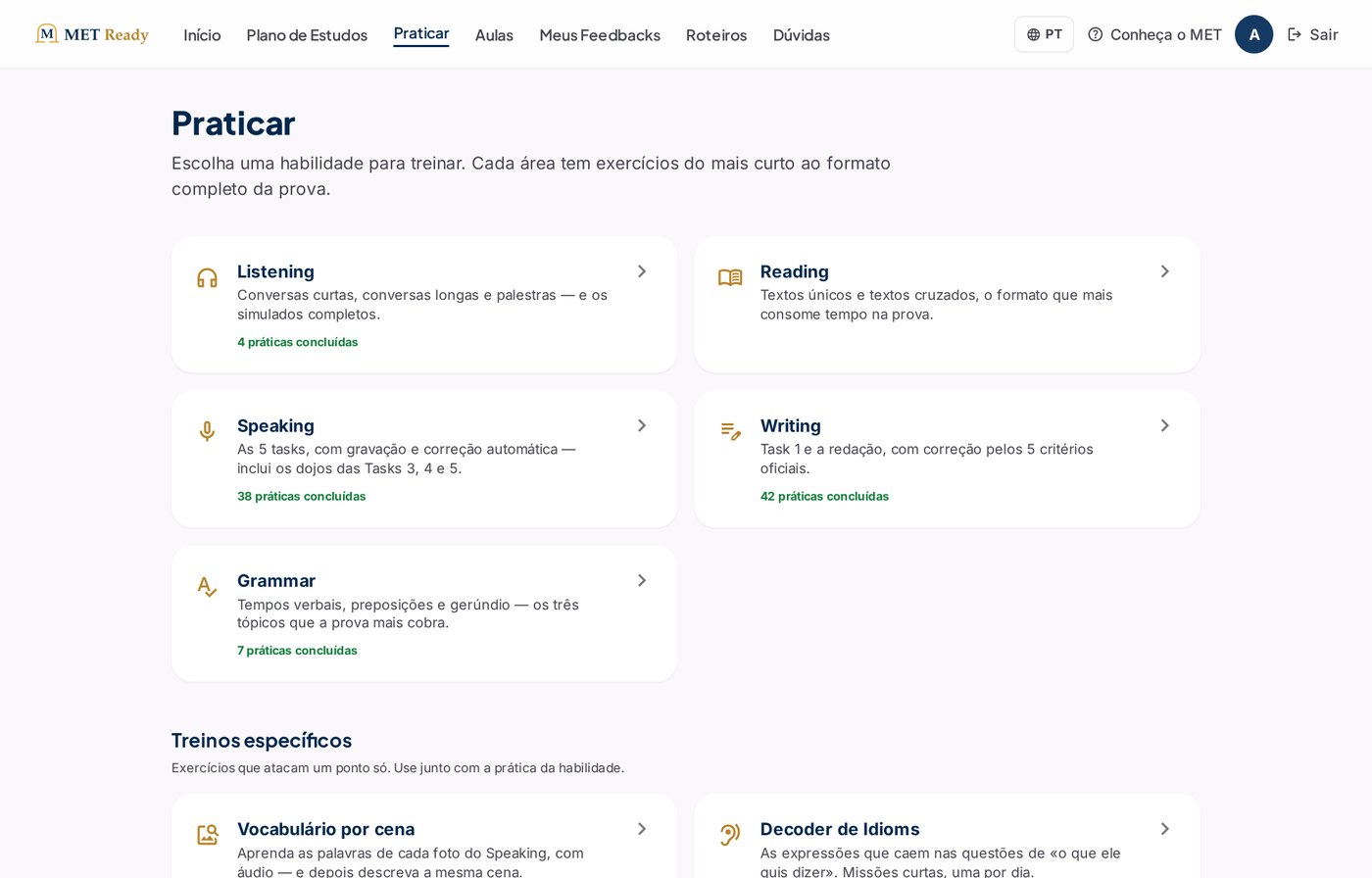
Practice
Practice. The door to each skill, with the count of what you have done, and the specific drills.
05
Reading & Grammar
Sections like the test, on the clock
On the test, Reading and Grammar are one score: 20 grammar questions and 30 reading questions in 65 minutes. Here you train full sections in real time, and grammar by topic, with the rule explained in every question.
Whole sections in the official formatLong and cross-text passagesTotal time and pace per questionGrammar by topic
Practice · Reading
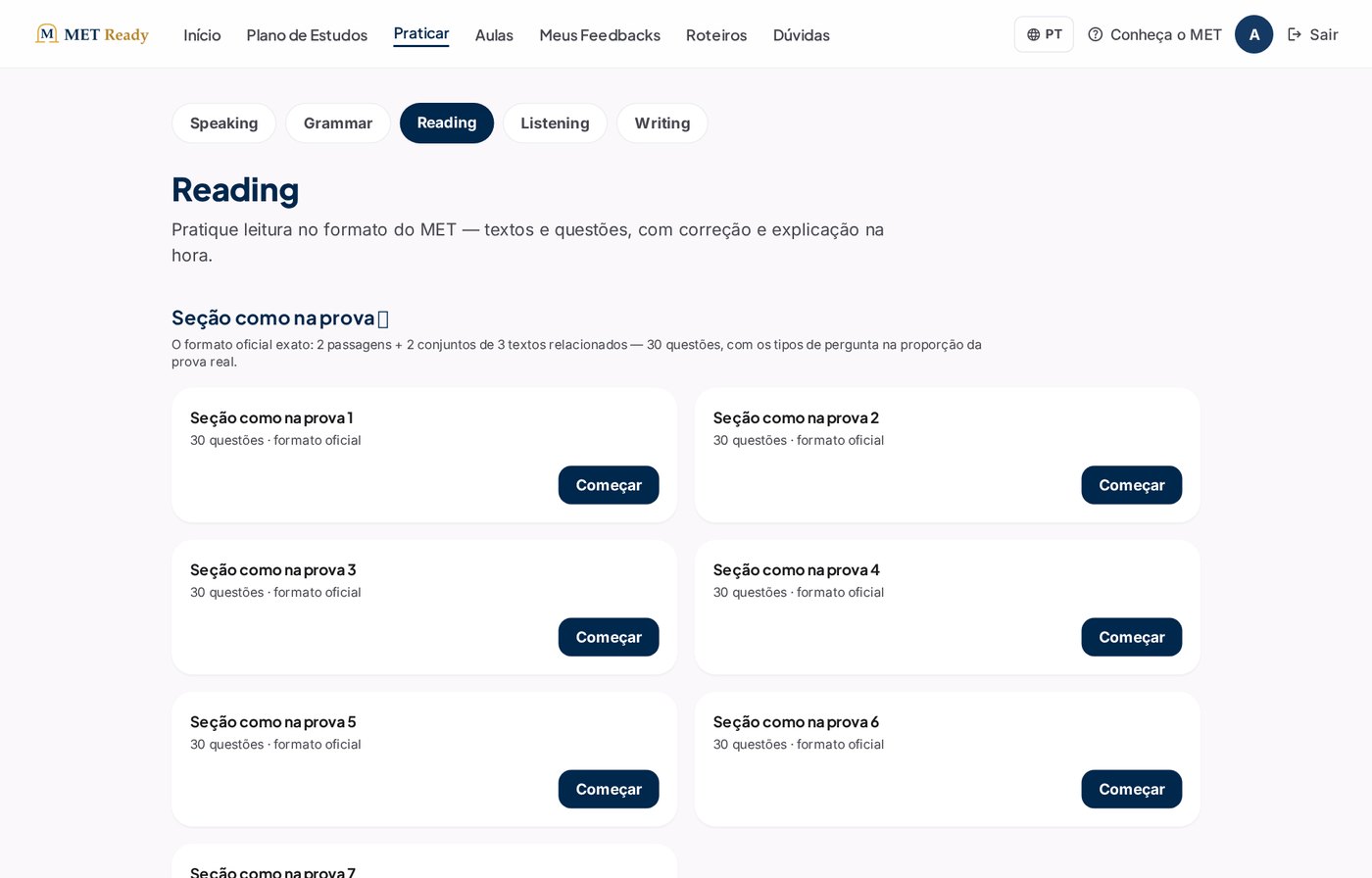
Reading. Whole sections: two long texts and two cross-text sets. At the end, total time and pace per question.
Practice · Grammar
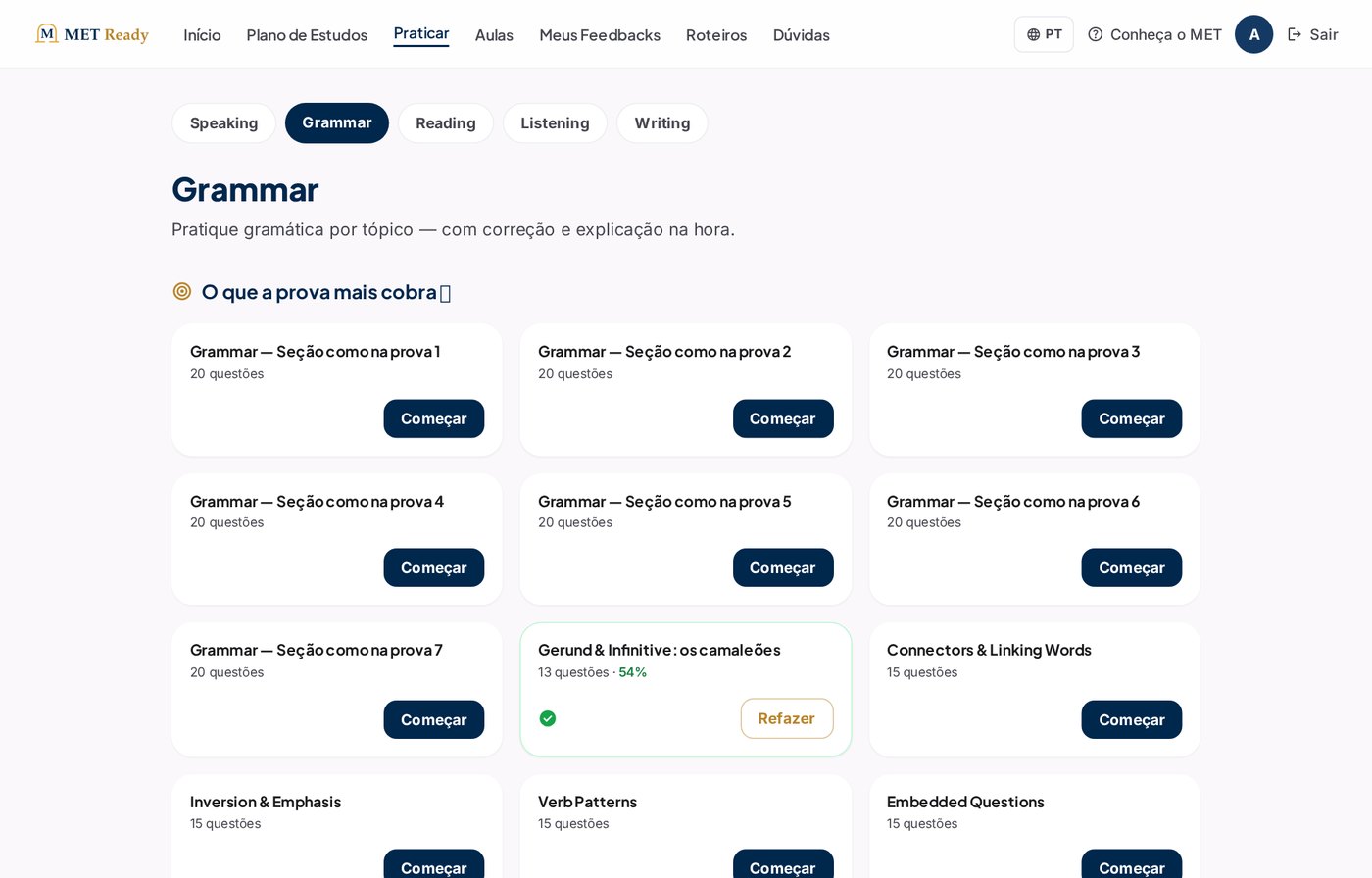
Grammar. Sections like the test and drills by topic: gerund and infinitive, connectors, inversion, verb patterns.
06
Writing
Write, get the correction, rewrite
Three places for Writing: the Studio, where you build the essay from the inside; exam mode, on the clock; and the Clinic, which gathers the points that repeat in your own texts.
5 official criteriaStudio · 8 roomsParagraph feedbackExam modeWriting Clinic
Writing
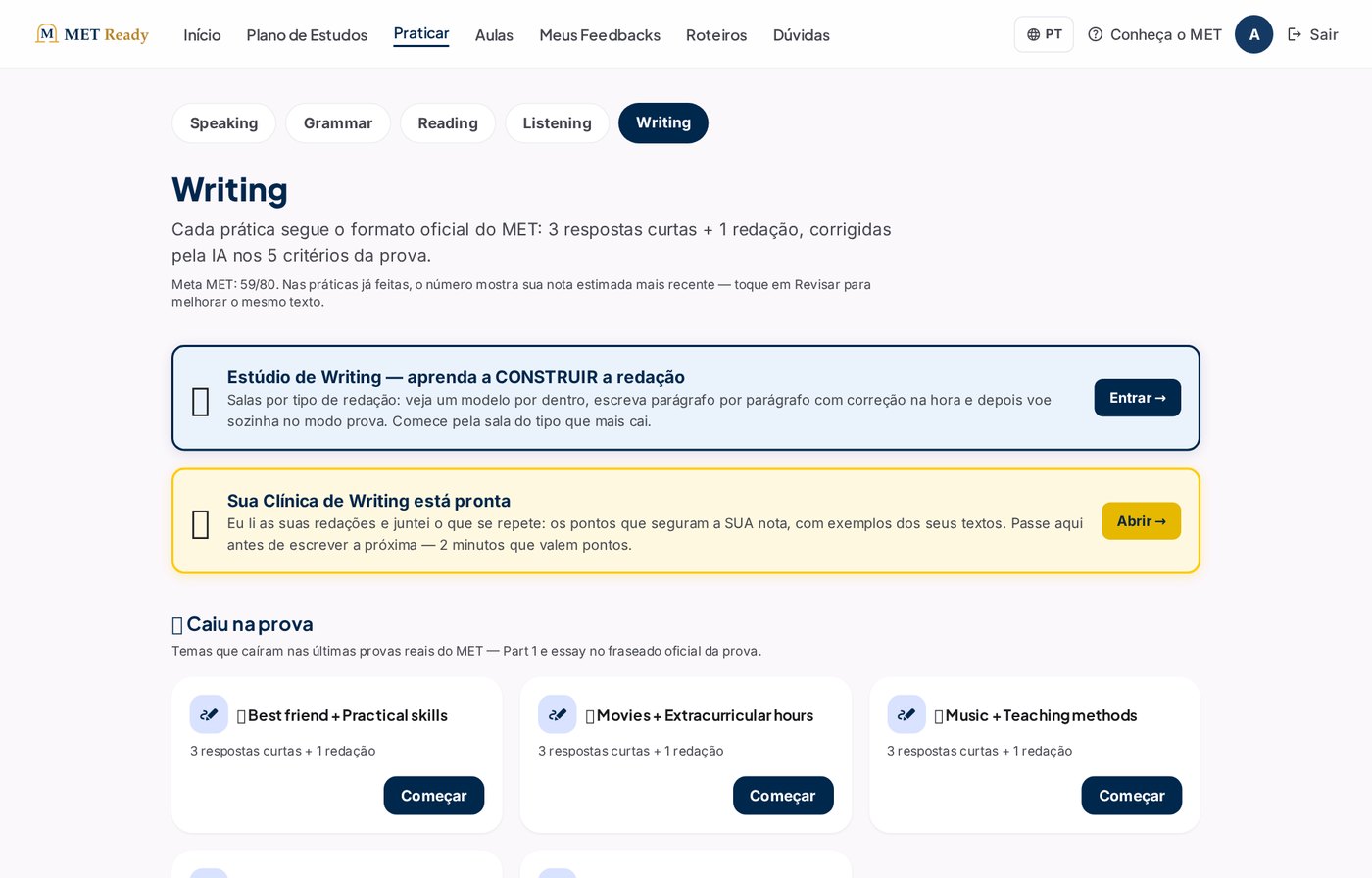
The Writing page. Task 1 and Task 2 scored on the 5 official criteria, with a score, comments and the rule behind each mistake.
Writing Studio
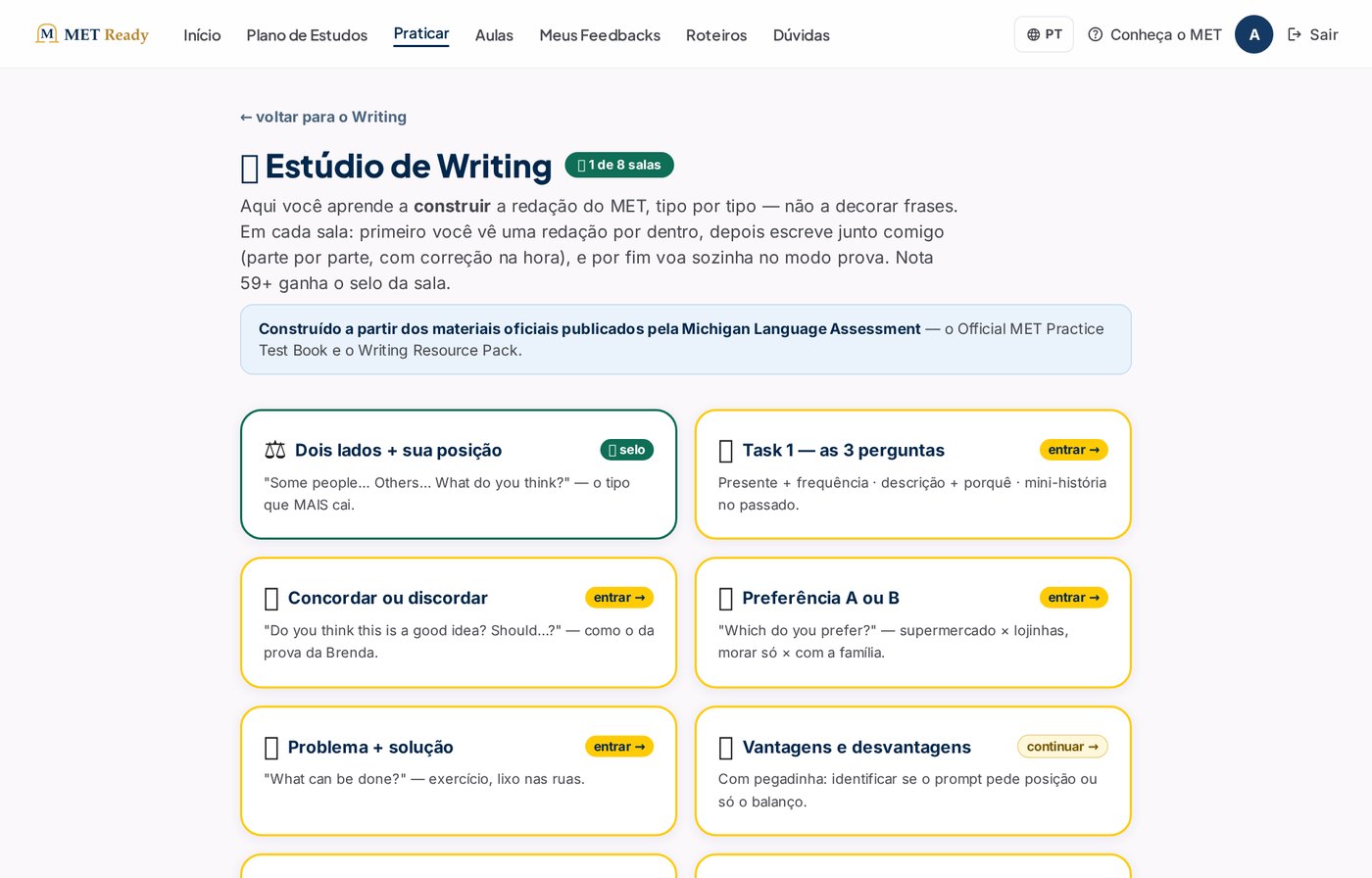
Writing Studio. Eight rooms, one per essay type: two sides, agree or disagree, preference, problem and solution, advantages and disadvantages, the most important quality, cause and effect, and Task 1.
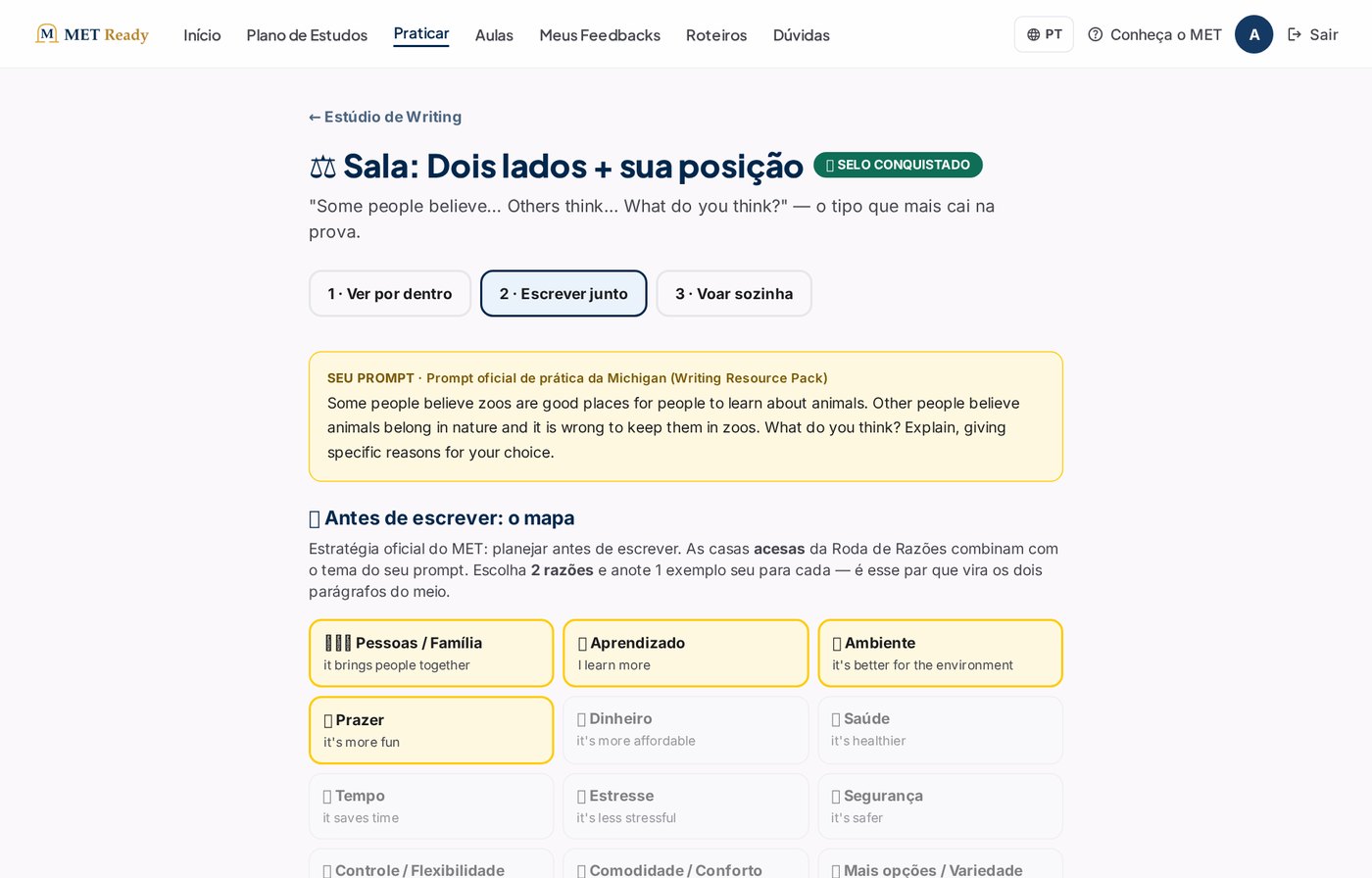
Room · Two sides + your position
Inside a room. The model from the inside, move by move, then your essay with paragraph-by-paragraph feedback.
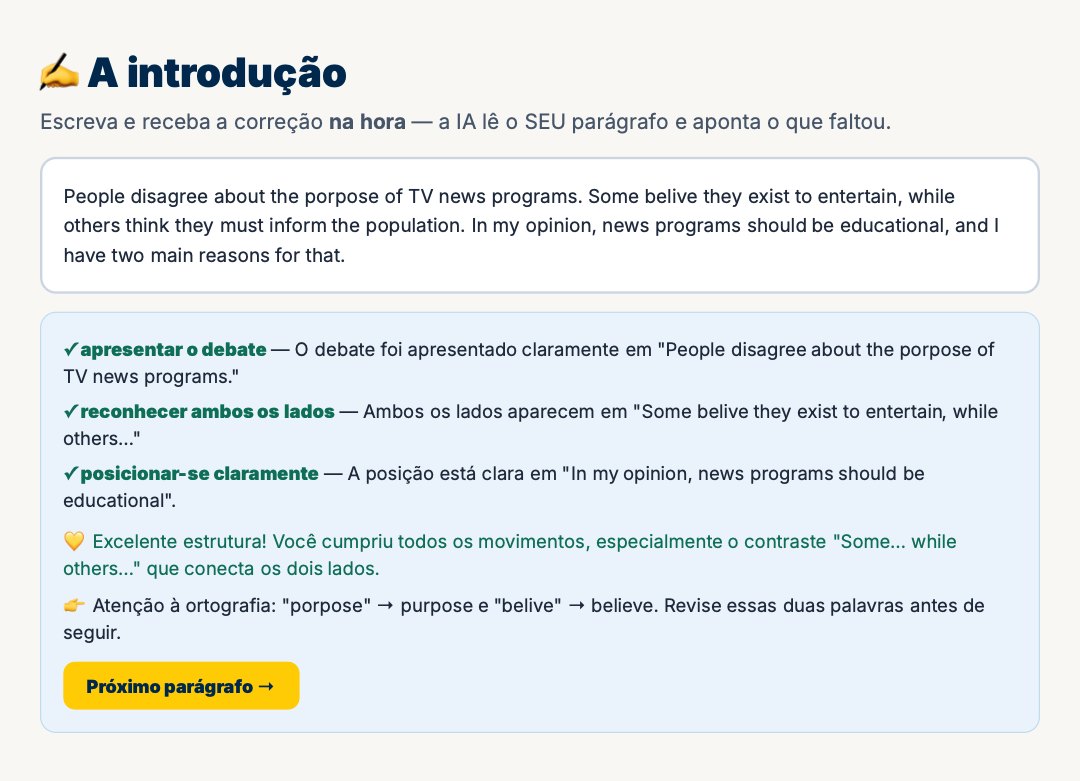
Paragraph feedback
Paragraph-by-paragraph feedback. As you write, each paragraph comes back with what held you back and the next step.
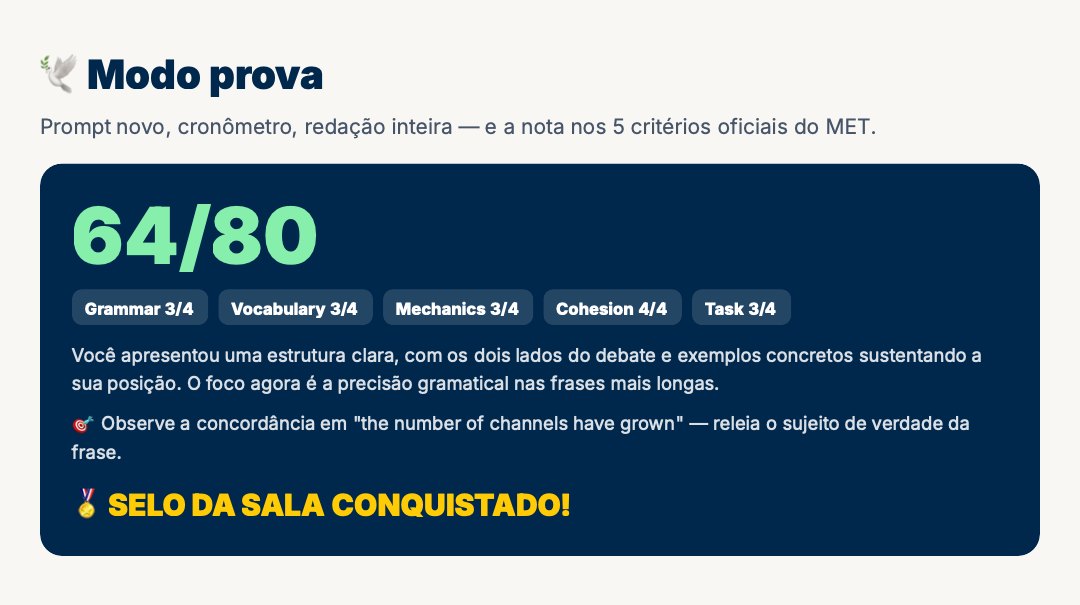
Exam mode
Exam mode. The essay on the clock, scored on the 5 official categories, with the estimated MET score.
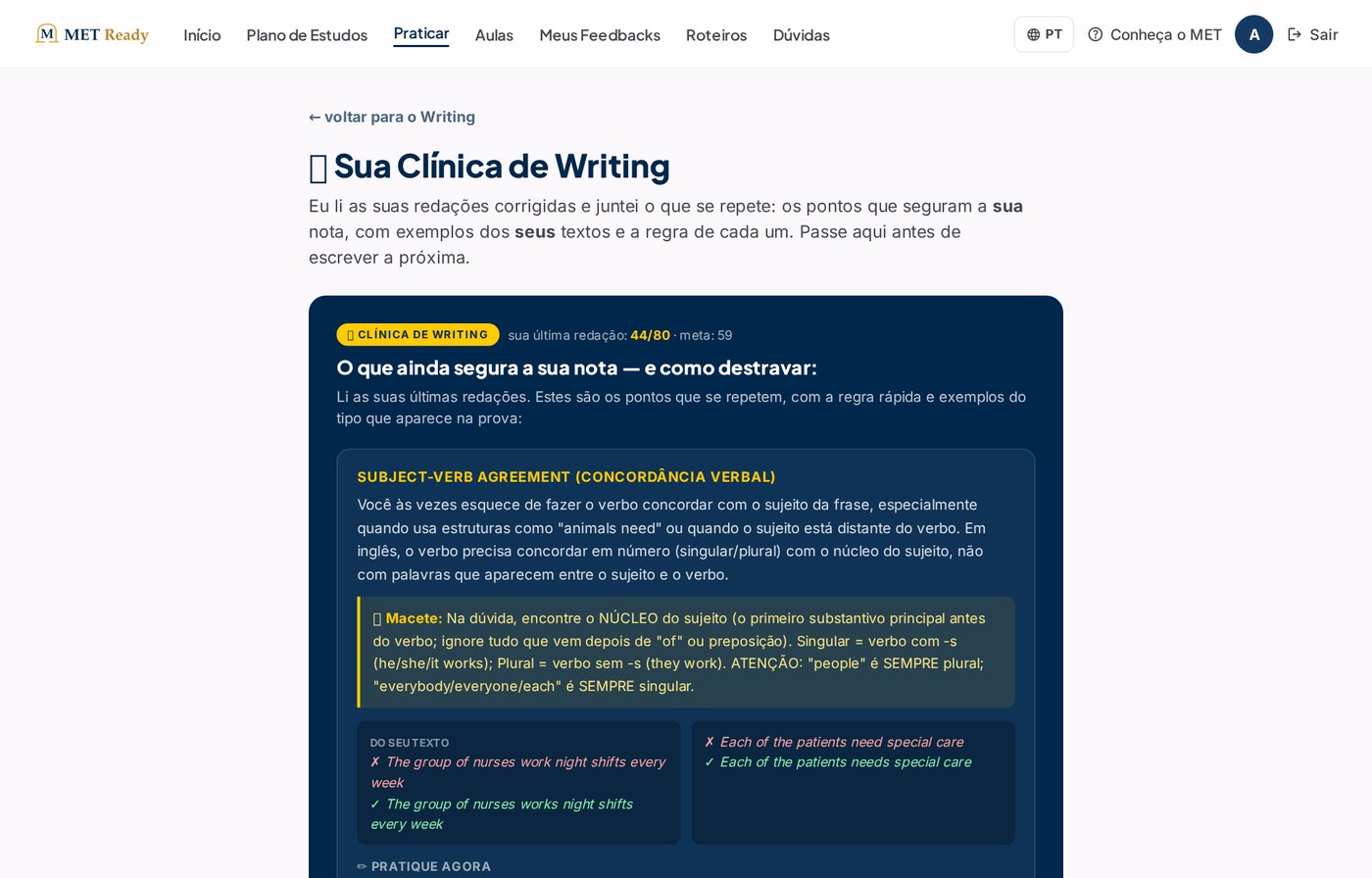
Your Writing Clinic
Writing Clinic. The platform reads your corrected essays and gathers what repeats: the points holding your score back, with examples from your own texts and what to do before writing the next one.
07
Speaking
Five tasks. Just you and the microphone.
You train each task the way it appears on the test, record, and the correction comes back on the 3 official criteria, with your answer rewritten at B2 to read aloud and record again. The video is narrated in Portuguese.
1
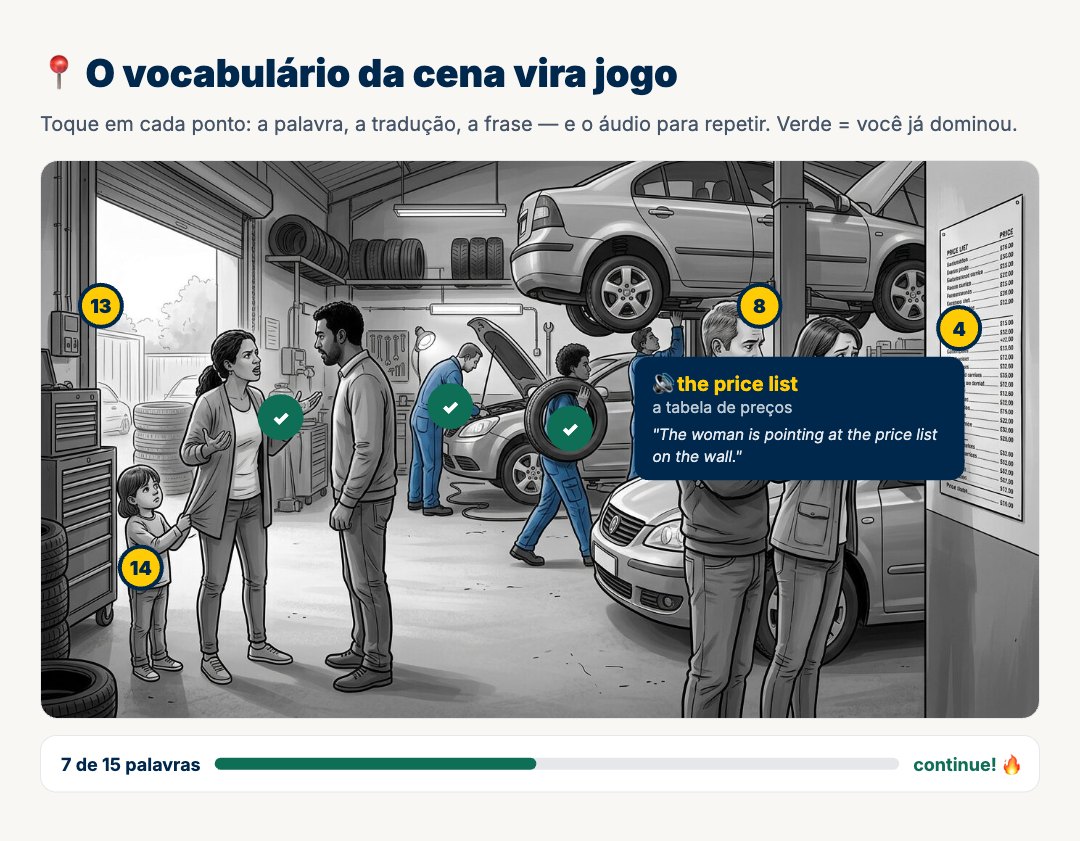
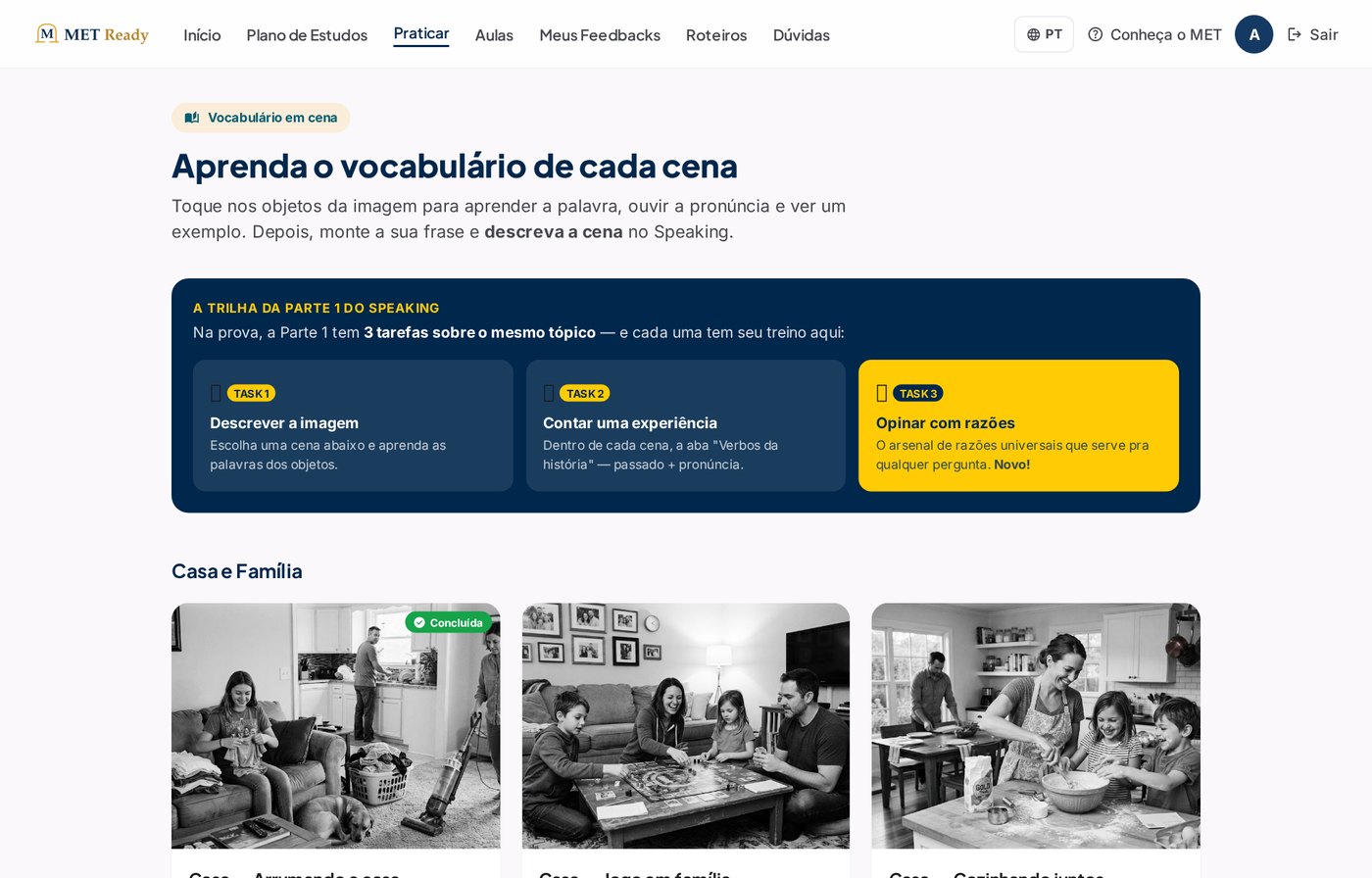
The picture becomes a game: the vocabulary of the scene before describing it.
2
The verbs of your story: the past tense ready before you tell it.
3
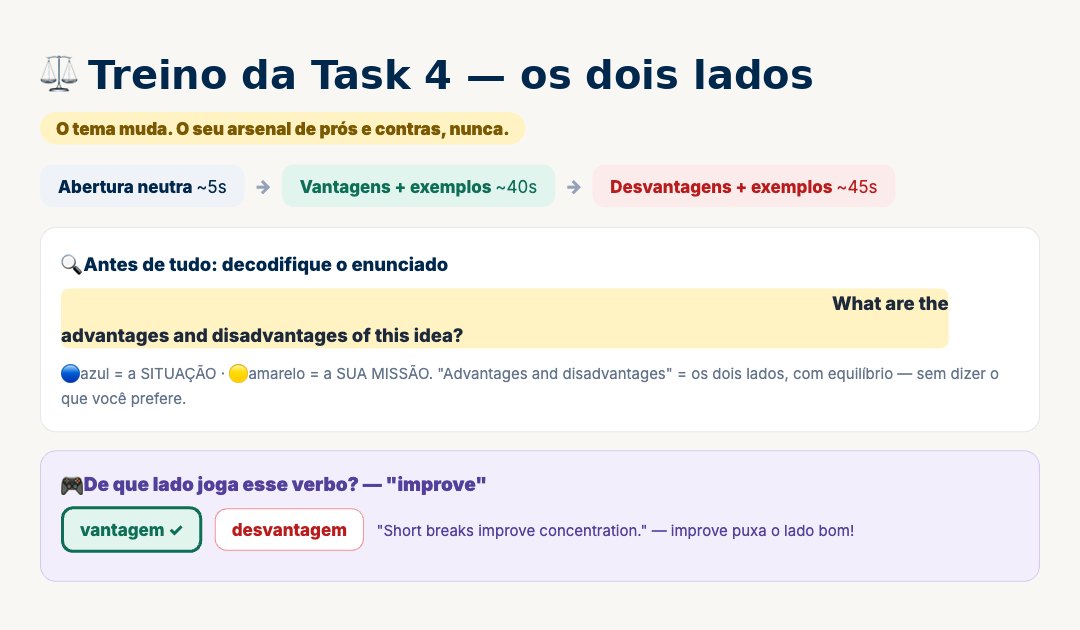
Step-by-step builders for Tasks 3, 4 and 5: opinion, both sides and persuasion, built block by block.
✓
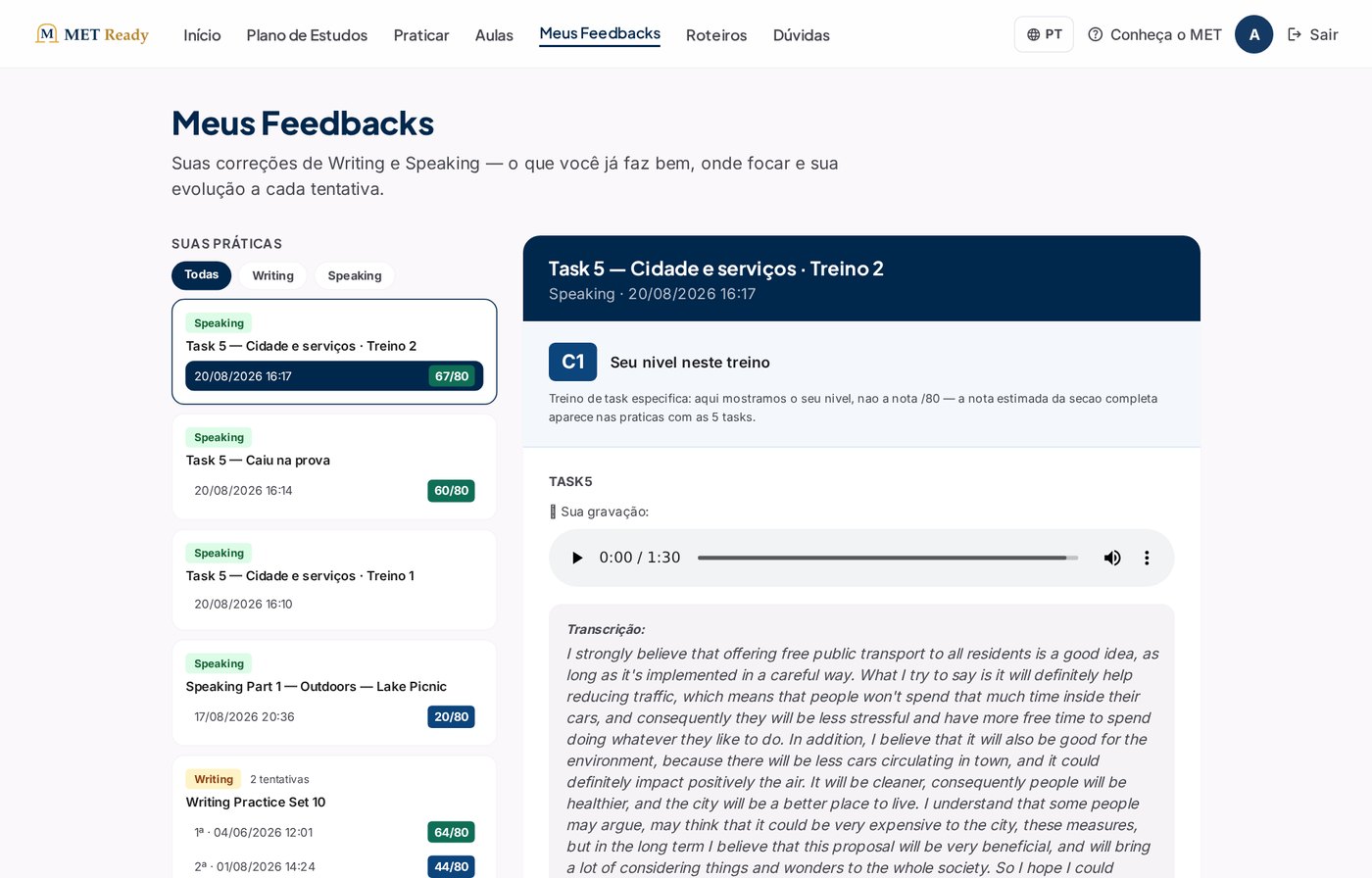
My Feedback: every recording with the score on the 3 criteria, the transcript and what to do next time.
Speaking · Train task by task
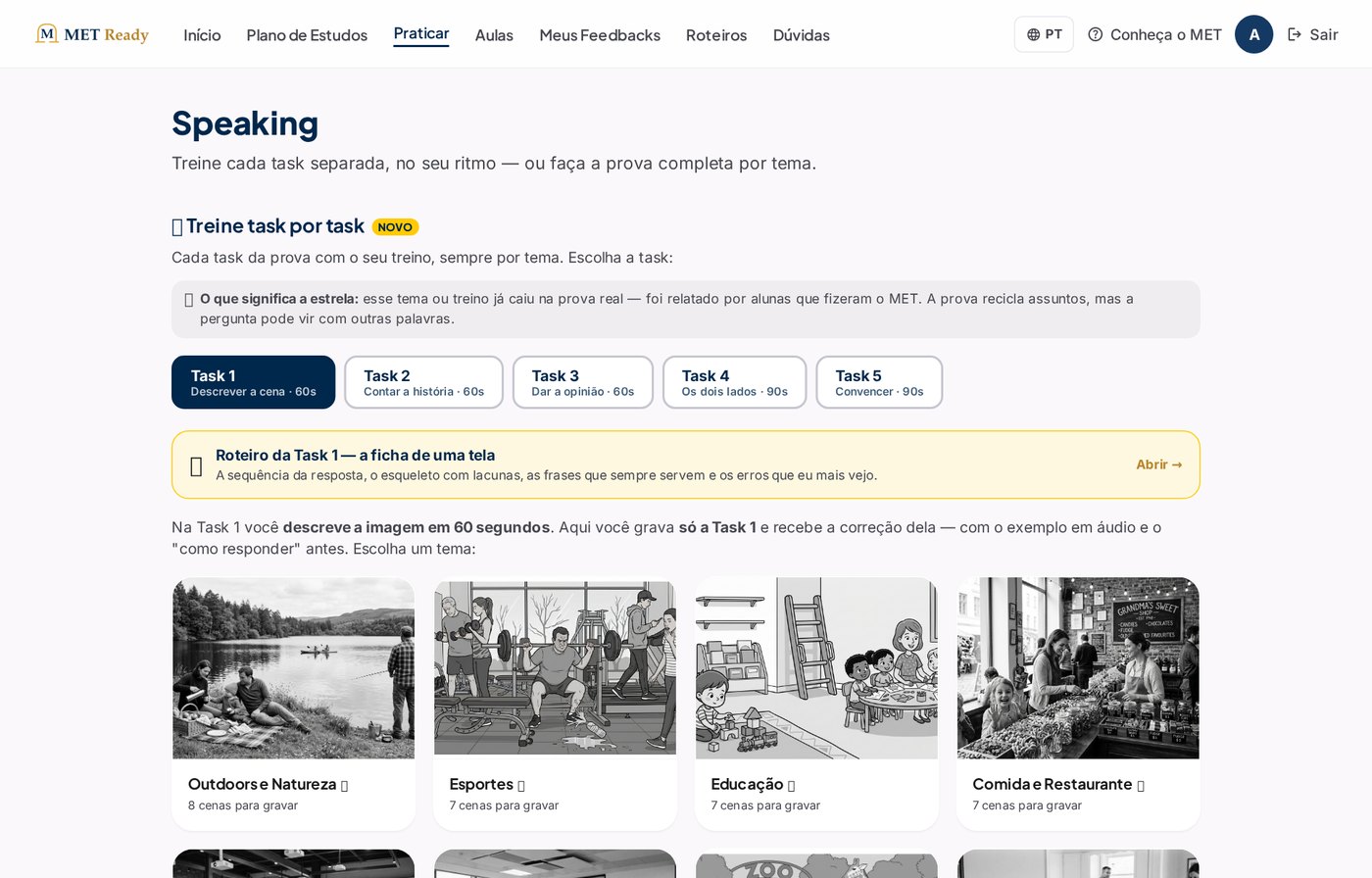
Train task by task. The five tasks, each with its timing, the topics, and the radar of themes reported by people who have taken the test.
My Feedback
My Feedback. The score on the 3 criteria, the transcript, the audio and the rewritten answer, recording by recording.
Picture game
The picture game. Tap the objects in the Task 1 scene to learn the word and hear the pronunciation.
Task 4 builder
Task 4 step-by-step builder. The prompt decoded, the arsenal for both sides and the answer built before recording.
Playbooks
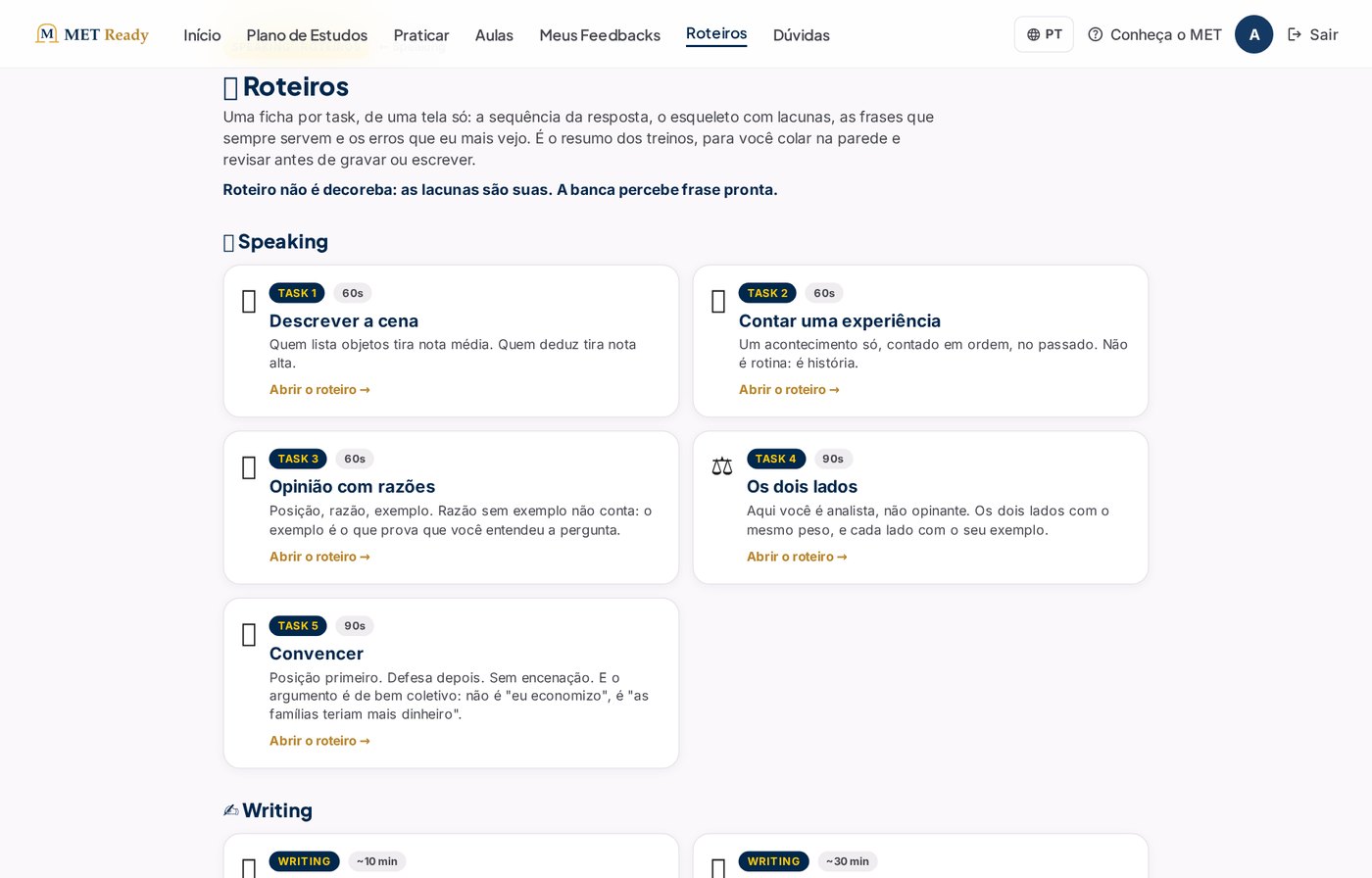
Playbooks. One single-screen sheet per task, to review before recording or writing.
08
Playbooks
A single-screen sheet for each task
The summary of the training: the answer sequence, the skeleton with blanks, the phrases that always work, a model answer with audio and the mistakes I see most. For the 5 Speaking tasks and for Writing.
Rescue phrasesModel answer with audioPrintable
09
Mock tests
Five full mock tests, in the exact format of the test
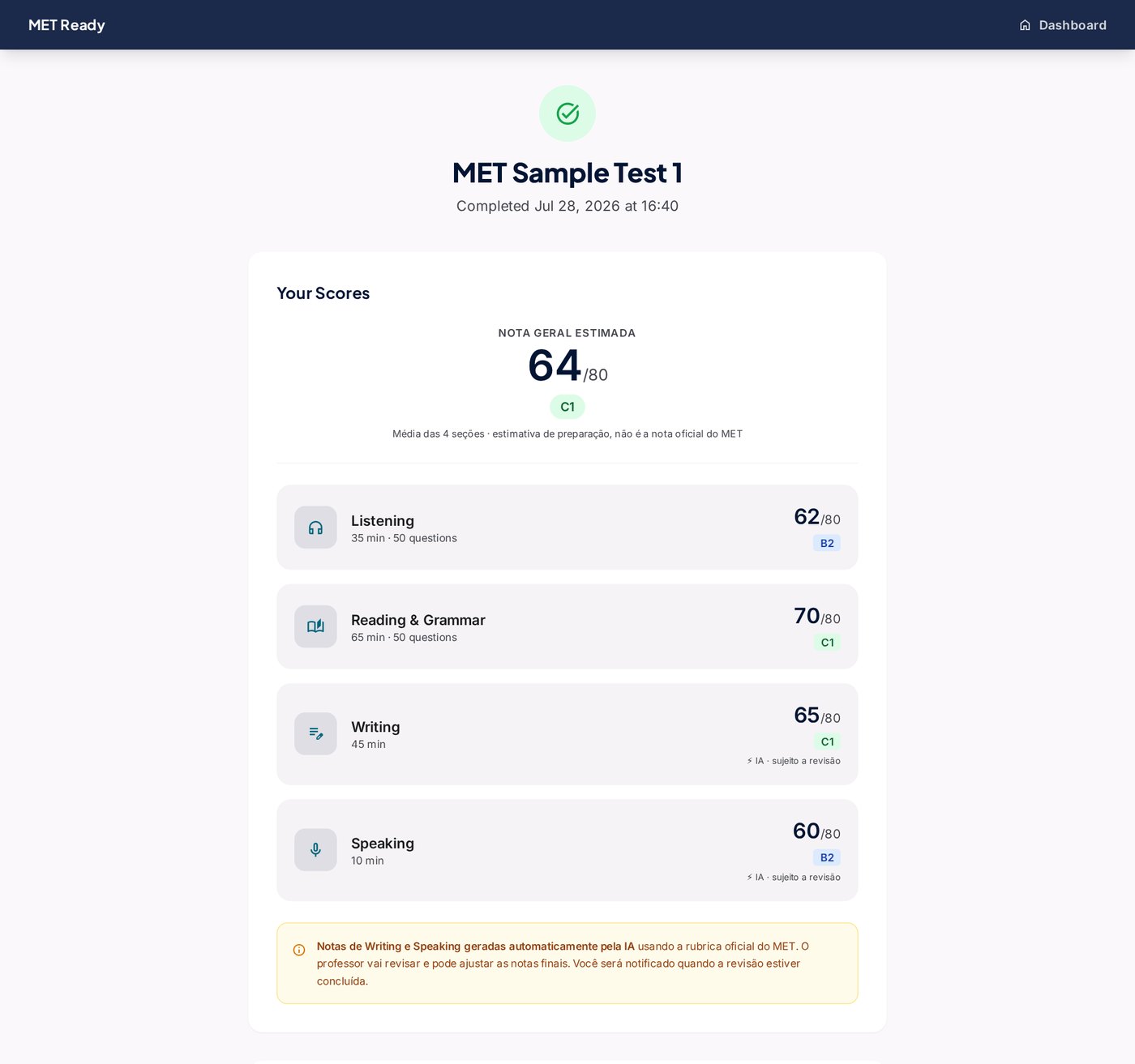
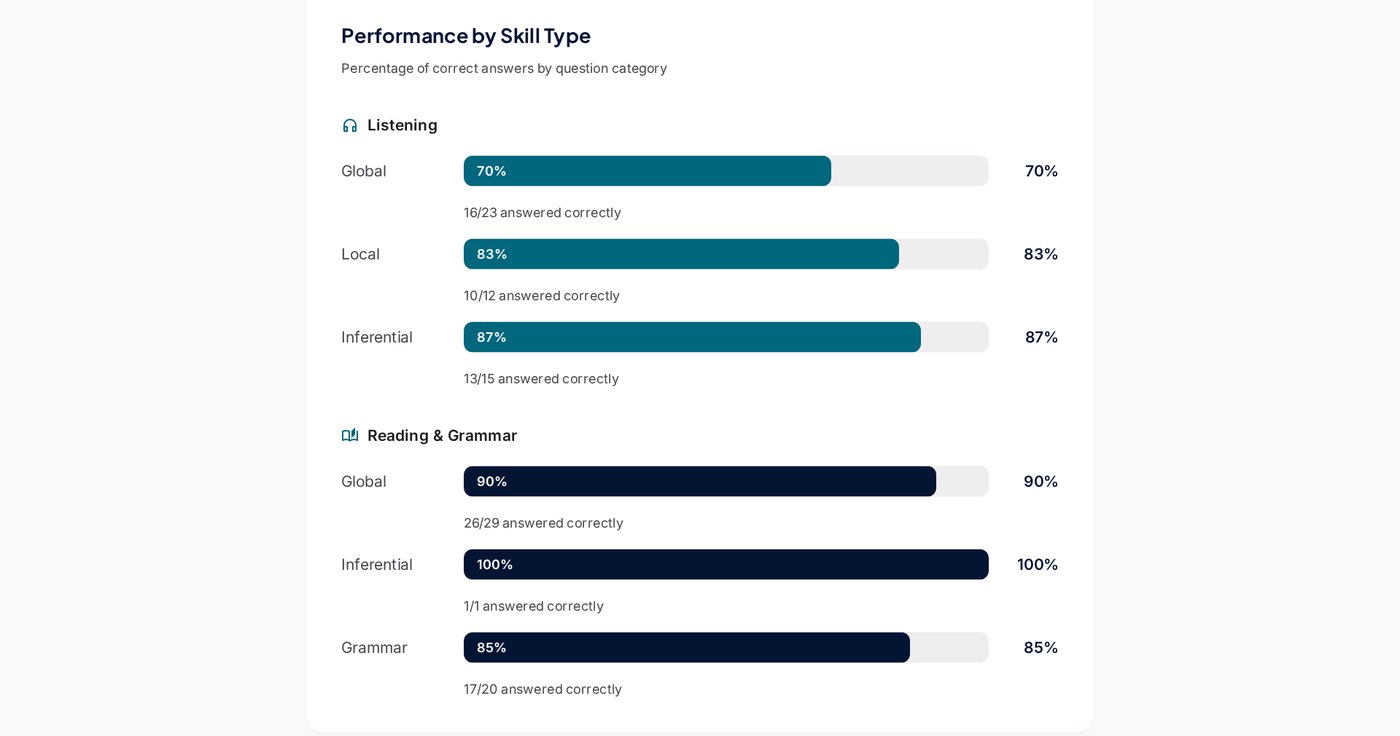
Same structure, same timing and same layout as the exam. At the end, the estimated score on the official 0-80 scale, skill by skill, the review of every mistake and your progress from one mock test to the next.
Result · estimated score
The estimated score. Overall and by skill, with the level.
Result · by question type
By question type. Where you score and where you lose points.
Result · progress
From one mock test to the next. One line per skill.
10
Exam Mind
Whoever has practiced has something to show. The job is making sure it shows up.
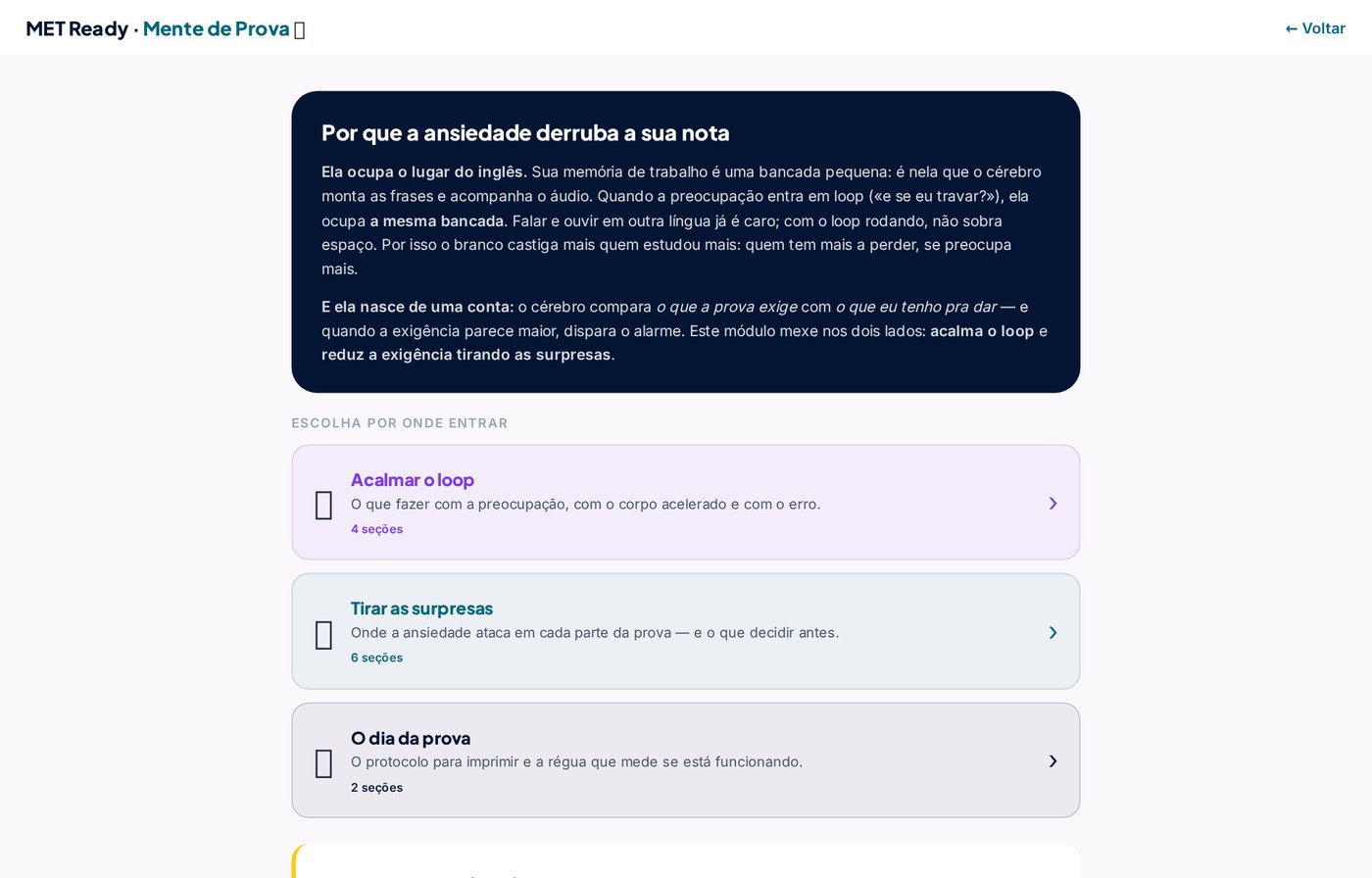
Anxiety costs points: it takes the place of the English. Exam Mind is the protocol for test day, in three parts, with no memorised phrases and no breathing exercises.
1
Calm the loop: what to do with the worry before it fills your head.
2
Remove the surprises: where anxiety shows up in each part of the test, and what to decide beforehand.
3
Test day: the protocol, to print and follow.
Exam Mind
Exam Mind. Why anxiety lowers the score, and what to do about it.
11
Vocabulary by scene
The words of the scene before you talk about it
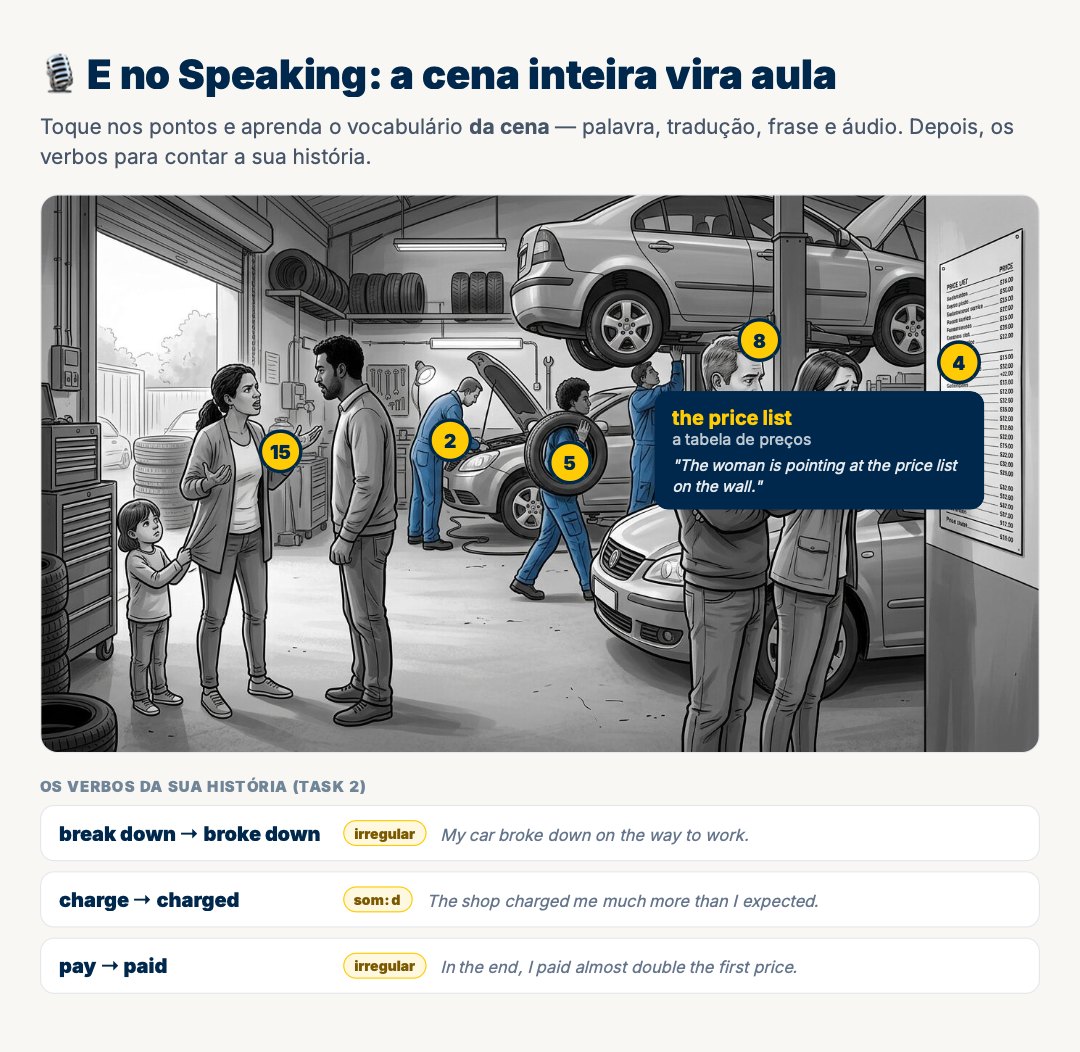
67 illustrated scenes, in the style of the test pictures. In each one you learn the words by tapping the objects, hear the pronunciation, build your sentence, and only then describe the scene in Speaking.
Vocabulary by scene
The Part 1 track. Each scene trains the three tasks on the same theme: describe, tell, give an opinion.
Scene
Inside a scene. The words, the verbs of the story and the reasons, all with audio.
12
A real correction
This is how the correction reaches you
Two answers of mine, scored by the platform on the official MET criteria, untouched. Notice that it points out the mistake, shows the right version and explains the rule. Feedback is written in Portuguese; the gist is translated here.
Speaking · Task 5 · 90 seconds
Convincing the mayor
Your city is considering offering free public transport to all residents. Supporters say it would reduce traffic, but others argue it would be too expensive for the city to afford. I am the mayor. Tell me what you think about this and try to convince me to agree with you.
"I strongly believe that offering free public transport to all residents is a good idea, as long as it's implemented in a careful way. What I try to say is it will definitely help reducing traffic, which means that people won't spend that much time inside their cars, and consequently they will be less stressful and have more free time… I understand that some people may think that it could be very expensive to the city, but in the long term I believe that this proposal will be very beneficial… So I hope I could convince you to agree with me."
3Task completion
3Language resources
4Intelligibility
Task completion: the answer is relevant and takes a clear position. You acknowledge the concern about cost, but offer no concrete counterpoints, such as examples from other cities or funding sources. The closing phrase "bring a lot of considering things and wonders" is vague.
Delivery: clear speech, minimal pauses, no long pauses. Fluid and natural delivery.
help reducing traffichelp reduce trafficAfter "help", use the bare infinitive, without "to".
they will be less stressfulthey will be less stressed"Stressful" describes what causes stress; "stressed" describes the person feeling it.
there will be less carsthere will be fewer cars"Fewer" with countable nouns; "less" with uncountable ones.
expensive to the cityexpensive for the cityThe preposition after "expensive" here is "for".
Your answer, rewritten at B2, to read aloud and record againI strongly believe that offering free public transport is a great idea, as long as we implement it carefully. First, it'll definitely help reduce traffic congestion. When people leave their cars at home, they'll spend less time stuck in traffic, which means they'll be less stressed and have more free time for things they enjoy. Second, it's fantastic for the environment. Fewer cars on the road means cleaner air… I understand some people worry about the cost, and yes, it will require investment upfront. However, in the long term, the benefits will outweigh the expenses. Cities like Tallinn have shown this can work.
Writing · Task 2 · the essay
Libraries: e-books only?
Some people believe that libraries should be fully computerized, with only electronic books, while others think libraries should continue to have traditional printed books. What is your opinion? Support your answer with reasons and examples.
"I believe that libraries should keep traditional printed books while also offering electronic books. … On the one hand, electronic books are very convenient. People can carry hundreds of books on a single device, search for information quickly, and read from almost anywhere. … On the other hand, printed books provide a different reading experience. Many people find it easier to concentrate when reading a physical book because there are fewer distractions. Printed books also do not require electricity or internet access, making them reliable for everyone. … In conclusion, I do not think libraries should become completely computerized."
3Grammar
3Vocabulary
3Mechanics
3Cohesion
4Task
Grammar, strength: you control complex structures well, as in "people can carry hundreds of books on a single device, search for information quickly, and read from almost anywhere": three coordinated verbs, clearly.
Vocabulary, what held you back: in "making them reliable for everyone", "reliable" describes something that works without failing, a machine, a service, not access to books. The grammar is right, the meaning is imprecise. Try "available".
Cohesion, what held you back: the move from the examples paragraph to the conclusion is abrupt. You give examples of students and children, but do not link them to the idea that libraries should offer both formats.
Rewriting taskReread the examples paragraph. Then add one summarising sentence before the conclusion that connects those examples to your main opinion. Try starting with "These examples show that…".
Both answers are mine, recorded and written while preparing for my own exam. The result on the official score report: 80 in Speaking, C1 overall.
+
Who already trains here
What students say
Written by the students themselves, published with their permission.
I started two months ago, and the platform has given me comprehensive training across all four skills. For Writing and Speaking it shows me my mistakes and exactly what I need to work on to reach my target score. The practice tests gave me a clear sense of my current level and how to direct my studies.
F
Fernandaregistered nurse · preparing for the MET
MET Ready is a complete platform for starting my preparation and tracking my progress. I learn the general-English topics the test covers and put them into practice right away in test simulations, so I can see my strengths and the weak points I need to work on before test day.
A
Anna Carolineregistered nurse · preparing for the MET
MET Ready, created by teacher Brenda, was a turning point in my studies. Given how little MET preparation material exists, this platform has made a real difference in all my skills, especially Speaking.
H
Hellenregistered nurse · now living in the United States
You have seen the inside. Now train.
MET Ready is the full platform for 4 months: everything on this page, with unlimited scoring. R$ 797 up front, or up to 12 card instalments (BRL).